
Reading and Watching
Ruminations on plays, cinema, Marat/Sade, Tennessee Williams, Genet and so on.

Some spoilers here and there.
Sad to say I didn’t watch that many movies for most of 2025. Some, sure, but not as much as I used to. Busy year for all things, life and bills to pay and writing. Being here on Substack definitely budded into my movie-watching time but I figured it was a good enough momentary sacrifice.
It wasn’t until a mass lay off that’s somewhat crippling my northern abode that I realized how much I missed sitting down and watching something new and astounding. I might have sighed the first time I laid back to finally dive into my collection of movies to burn through. It’s a different kind of relaxation. Reading books is more work than watching a movie – but a real good film is not an empty thing.
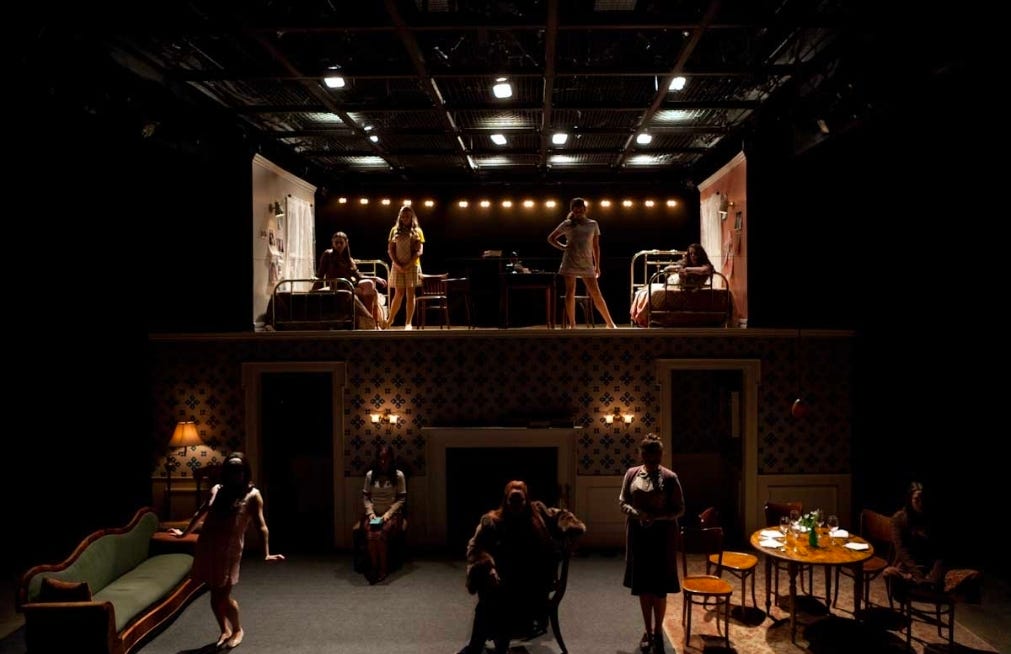
For the first half of this year I’ve read a small dozen plays for fun and to set myself into a certain mood for a play I’ve started working on myself. I don’t know what it is about the aesthetic of a play that’s always attracted me since I first saw one. There’s a magic to theatre that trumps aspects of cinema. I think for me it has to do with the darkness surrounding the actors on a stage, the darkness they equally stare into when reciting their soliloquies. Plays are also a perfect example of minimalism if that’s your thing. I’m sure you could write a play with more detail – maximalist play? – but I think from what I’ve read, the filling out the details comes in the production itself. Otherwise, you could do what Beckett did when writing down the setting of your script like in Waiting For Godot: “A country road. A tree. Evening.”
Here’s a list of what I’ve read this year so far, not including novels:
Peter Weiss’ Marat/Sade. Tennessee Williams’ The Glass Menagerie, A Streetcar Named Desire and Suddenly, Last Summer. The original Marlowe version of Dr. Faustus. Goethe’s Faust: Part One – Part Two I’ve yet to get to – and Jean Genet’s The Maids.
Nothing crazy, really. As for a few others on my shelf, I still need to get to Tom Stoppard’s Rosencrantz and Guildenstern Are Dead, Miller’s Death of a Salesman and The Crucible, Lorca’s Three Tragedies, O’Neil’s Long Day’s Journey Into Night and Genet’s The Blacks and The Balcony.
During the binge, I’ll probably read Shakespeare at some point. Hamlet and the usuals, obviously, but there are a few more I haven’t red yet. I might also reread Oedipus the King and the Oresteia, the latter I’ve not read, among other Ancient Greek plays. Long Days Journey Into Night is something I’ve had on my shelf for quite a while but never approached it yet as I’ve heard it can be quite a depressing tragedy, but I’ll have to try it sometime, right?
Among these plays, I’ve also watched many of the films adapted out of them. All versions are equally praiseworthy. A Streetcar Named Desire among its 1951 film version is an amazing experience. Brando played Stanley’s character in the stage adaption far before the film more than 800 times and it shows. I wish we had footage of what that acting performance was like in those first few to compare his change by the time of the film. All of Williams’ plays are amazing, or those I’ve read. The three plays of his I’ve read border something dreamlike at times. The Glass Menagerie for it being a memory play, but even Blanche’s attitude in Streetcar being one full of magic and whimsy, though easily shattered by Stanley’s outbursts. And then you have the climax of Suddenly, Last Summer, and I don’t even know what to say about that one. Pure pandemonium is a good description, heavy on the Freudianism which always shone through Williams’ other works.
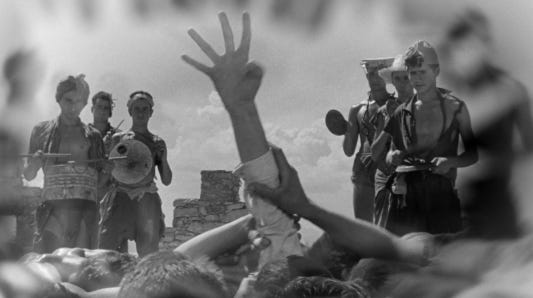
Jean Genet’s The Maids was also a great read and watch. I laughed during most of the reading, then noticed I had laughed more from reading this stack of plays than I have most books. It cold be my fault, for a long time I never felt like humor worked much in a story. Gravity’s Rainbow was a good exception, also parts of Moby Dick here and there. But maybe it’s my own attitude about things, exploring humor in my work and slowly discovering the humor of classics as I’ve gone to reread them. Dostoevsky is full of comedy in each of his books if you choose to read it that way, even McCarthy’s dark humor in recent rereads has pulled a few laughs out of me.
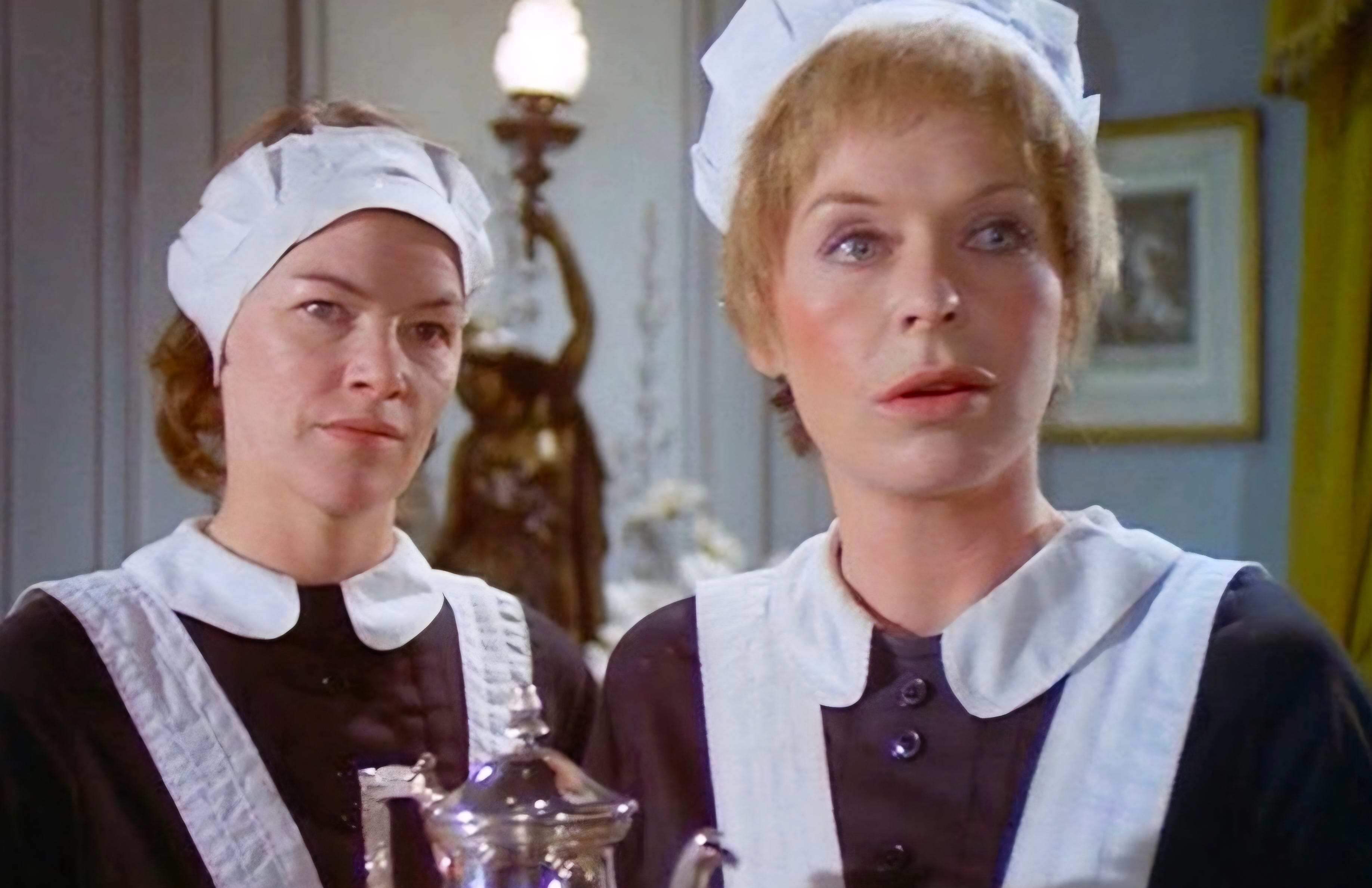
Anyway, The Maids, if anyone is wondering, or cares, is about two sisters who take turns playing as their madame when she is away. They play it as a sort of game, bickering, even striking one another until, by the end, the maid is allowed to let out their anger on the temporary madame. There is even – true to Genet - a sadomasochistic angle to their game. The end goal to this performance is to poison and kill their madame in real life. I won’t spoil much else but both the written play and the movie are fantastic. Glenda Jackson playing as one of the maids steals the show from the moment she begins speaking. It almost gave me a feeling of whiplash to see her act this way as opposed to the stark difference of her role in Marat/Sade. The theme of Genet’s work often involves the body, criminality, queer sexuality and power dynamics. He was a thief in his own day for much of his life, spent years in and out of prison and wrote his work often behind bars. He wrote books before entering theatre, and from what I’ve read many of them are semi-autobiographical, but goddamn is it hard to find him at my used bookstore. Not that he never shows up, as the storeowner always tells me, someone else just comes by to pick him up as soon as he puts his work on the shelf. He’s quite the interesting character and I’m eager to read more about him as well as his work.
The Persecution and Assassination of Jean-Claude Marat as Performed by the Inmates of the Asylum of Charenton Under the Direction of Marquis de Sade. Or, Marat/Sade, is probably my favorite of these plays I’ve read. It might even be my favorite play and the movie isn’t that far away either. A play within a play in which these asylum inmates perform before another audience, taking place as a fictional debate between the Marquis de Sade and Jean-Claude Marat, with de Sade working as both director and actor. Like Genet, the play explores themes of power dynamics between the high and the low, set in 1808 during the reign of Emperor Napoleon, the play takes us back to the French Revolution in which Marat argues for policies which – by the time of the play – have led and will lead to countless deaths by guillotine, not only of the aristocratic class, but also the citizens the revolutionaries called up arms to originally defend, all while Sade, representing a sort of anarchism, slides into cynicism and nihilism in his arguments against Marat’s perceived utopia through slaughter, supporting the sort of freedom the revolution promised but also criticizing where it eventually leads: to a high aristocratic class and a poor population still struggling to find food. Just another revolving door. It’s philosophical, asking questions surrounding human nature and freedom, all of it presented while the inmates of Charenton sing of their class struggles that never really change. Being that every actor in Sade’s play is an inmate of Charenton, the performance often dissolves into lunacy and disorder – occasional bursts of laughter in the background between another’s line, stopped by orderlies dressed as nuns and occasionally shut down by the director of the asylum himself to warn Sade about other actors using censored lines.
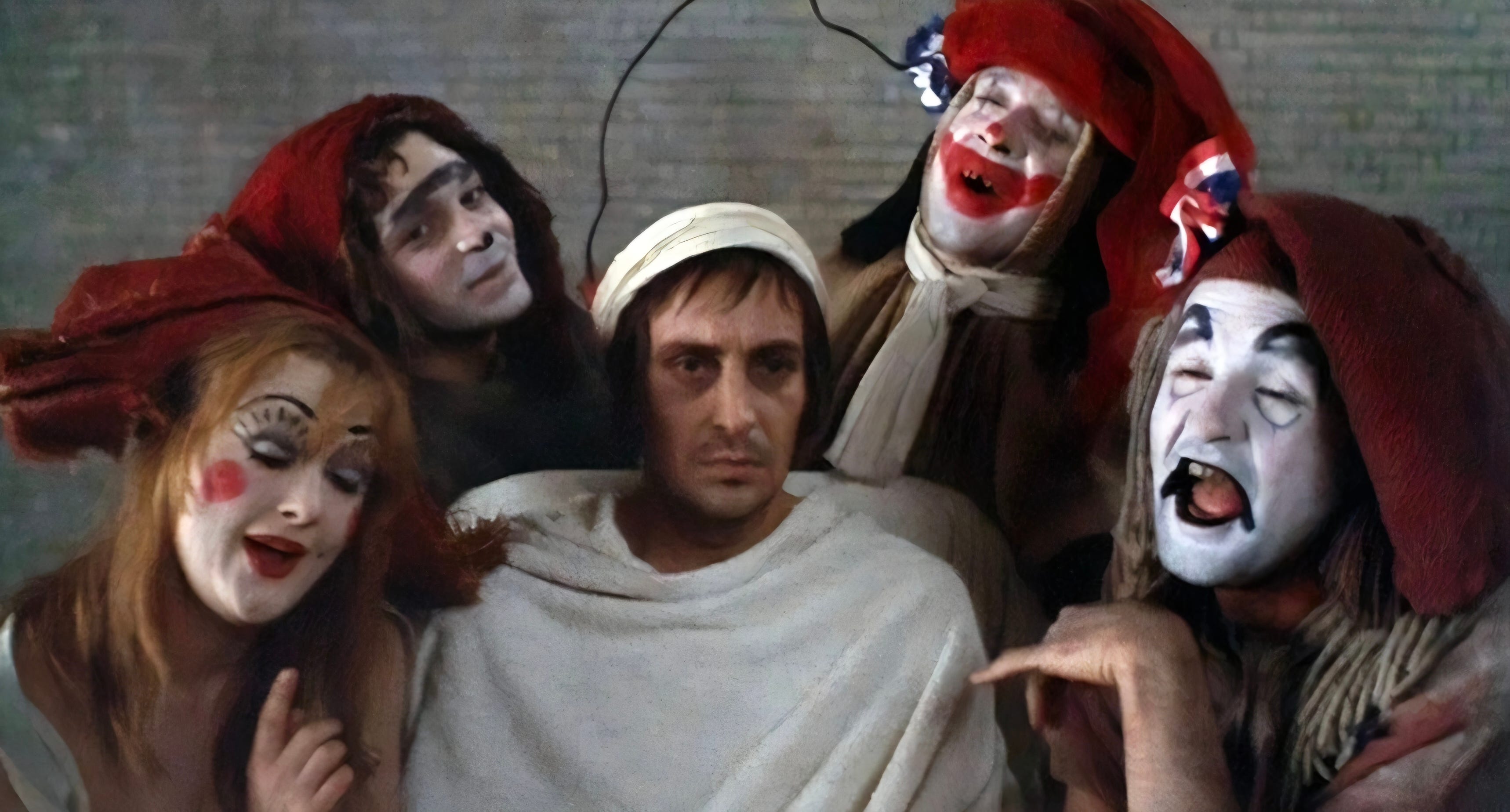
Photos of various stage productions of Marat/Sade are outstanding and I long for one to be performed close enough for me to see it. The film is another wonder. Sade is brilliantly acted by Patrick Magee and Glenda Jackson once again shows off her skills as Corday as if it were easy – a character suffering from melancholy and sleeping spells, who stutters and speaks softly; a far cry from the furious and sniveling Solange in The Maids. The way they use the setting of the asylum bathhouse as a stage, using various props to mimic the sound of a guillotine with various inmates dropping into a pit to appear like a pile of heads. Outstanding stuff, perfect performances. Oh, I didn’t even mention it’s a musical. The way the play is written – almost Jacobean – lets you fall into the rhythm of the various songs throughout with ease, even coming with song sheets if a reader wanted to get the full picture in their head.
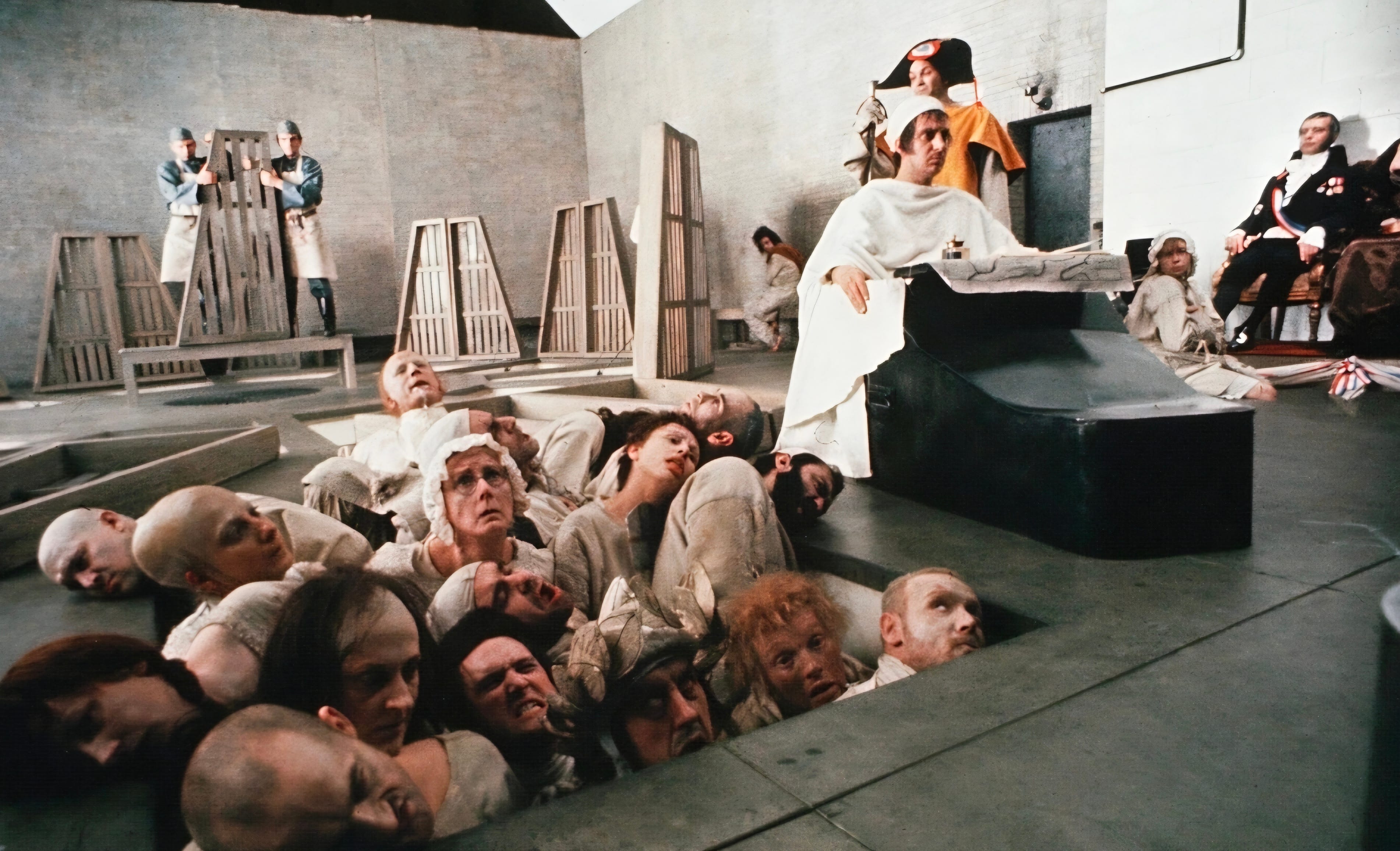
In my edition, Peter Weiss gives a much-admired historical background of the play I wasn’t aware of. Turns out Sade, who spent much of his life in prison and insane asylums for the vulgarity of his work and a dozen heinous crimes – even ordered to be placed under arrest by Napoleon himself – would produce his own plays while locked up in Charenton. Apparently they were quite a specialty and were even attended by aristocrats from all over France. All in all, Marat/Sade is an amazing play and a very quick read, could even finish it in a day.
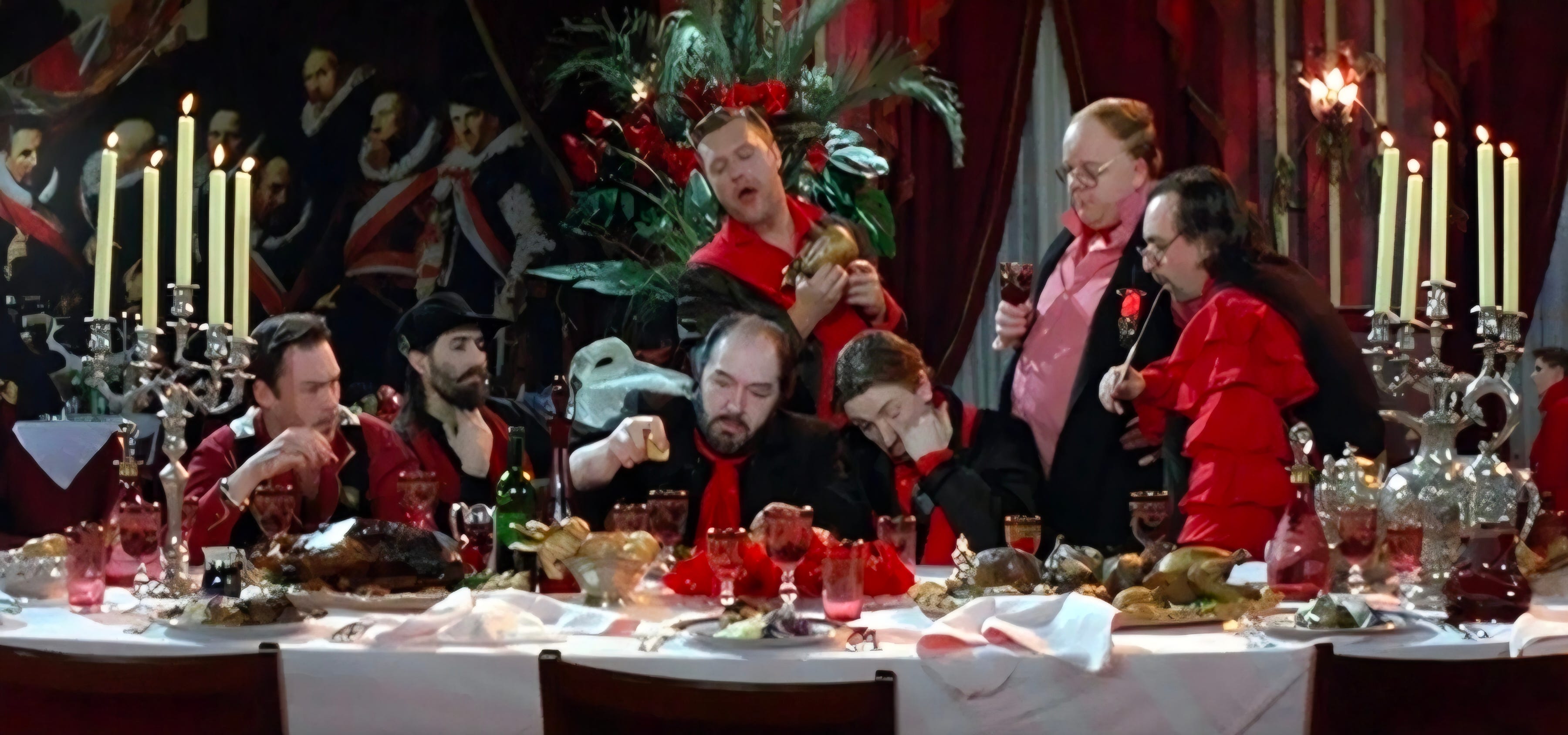
Some more banger films for you. Funny thing is, and I don’t know if this is because I’ve been reading so many plays in a row, but my favorite films of this collection present themselves as a plays on their own. The Cook, The Thief, His Wife & Her Lover was the most glaring. Besides the stage play comparisons, every shot is like a damned painting. Wide, taking up whole rooms with colors from greens to reds and white filling the screen. The clothing design is perfect, the color of a character’s clothes even changing depending on which room they’re in to deepen the emotions of each scene. The musical score is spell binding, composed by Michael Nyman, it sets the tone from the very first shot and adds to this tension throughout the film that only eases off just a little throughout at times, but never truly goes away until the very end. This tension is also heightened thanks to the outstanding acting, the thief of the film particularly also stealing the show like Glenda Jackson does in her roles. Albert Spica, played by (Dumbledore) Michael Gambon – holy shit, what amazing acting. He plays a vulgar criminal who has recently taken over the restaurant most of the movie is set in. Every night he dines there with his thugs, fighting – sometimes physically – with the staff and other patrons, effectively scaring off the clientele. He’s loud, obnoxious, violent and unpredictable. He never stops talking! He brings along his wife, Georgina, played by Helen Mirren, and constantly abuses her both verbally and physically throughout the runtime, all while she spots another man dining in the restaurant and takes him as her lover. As I was trying to explain earlier, the film is the kind that grips you at once from the moment it starts and never let’s go, leaving you – it certainly did me – with a sigh of relief when it’s finally over.
Two other films I want to glorify real quick, which also reminded me of plays. Iranian films, Taste of Cherry and It Was Just An Accident. No, I’m not watching them because of what’s going on in the world currently, I’ve just had them on my list for years and have yet to get into Iranian cinema out of others, so you can fuck off regarding any opinions. I’m still fresh on It was Just An Accident so I probably won’t go too deep. It’s about a man who takes matters into his own hands when he recognizes the squeaking of a man’s prosthetic leg as that of his past torturer. Yet, filled with doubt, he goes to find other political prisoners who suffered similar abuse by the same man to confirm whether it is really him or not before carrying out his other plans. Let me just ramble on a bit more about theatre to be annoying – you could see this movie on a stage no problem. There’s even a reference to Waiting For Godot. At one point the characters of the movie are all sitting around waiting and pondering, spread out across the screen in various poses that stuck out to me as something you’d see on a stage. This could also have to do with the more “subtle” its director, Jafa Panahi, had to film it due to the state of filmmaking in the country. Wonderful film, one I was never bored watching, all of it leading up to a perfect climax and a final scene that sticks with you.

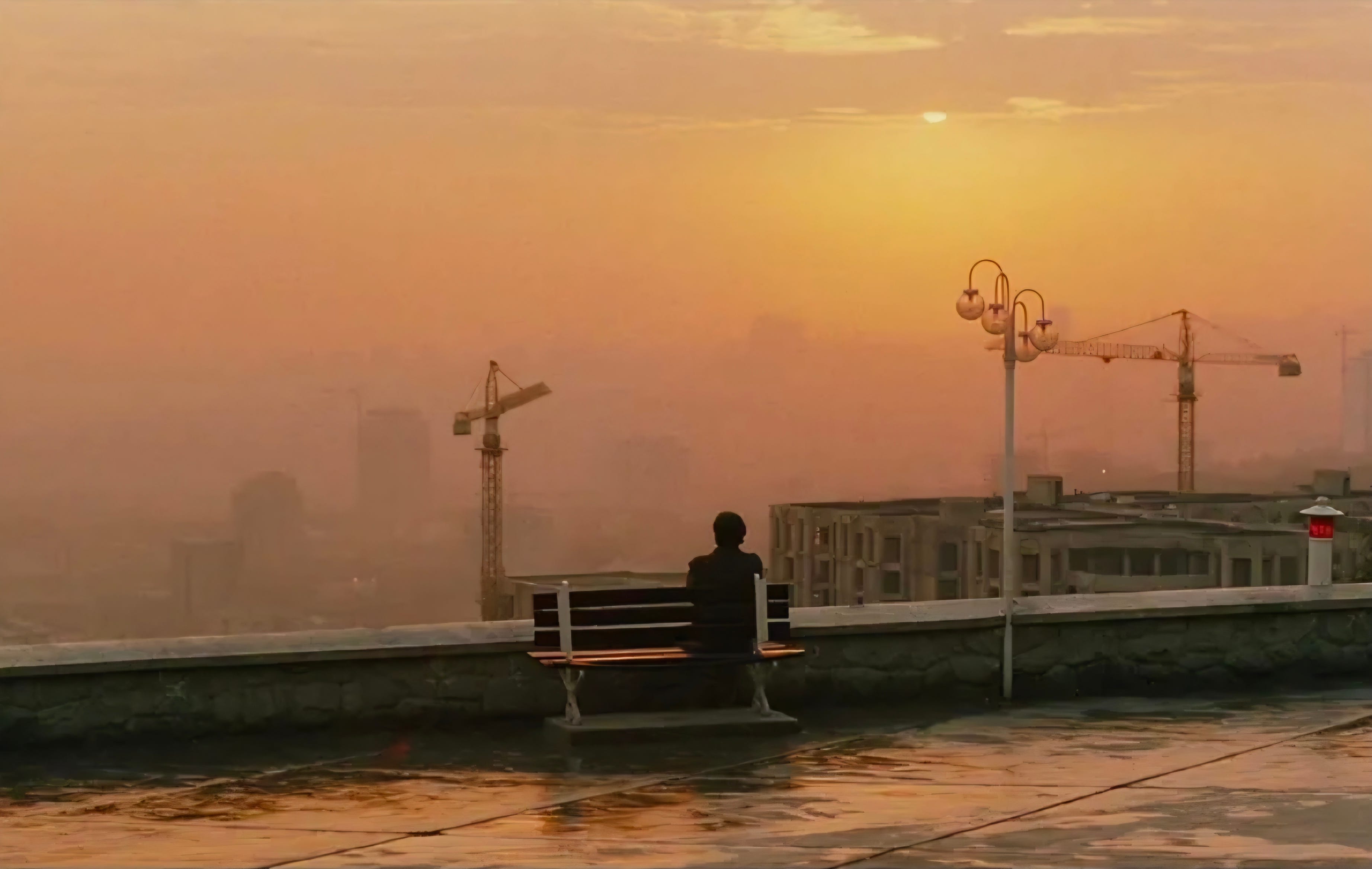
Taste of Cherry doesn’t so much as present itself as a play but you can see how it could be acted out that way. It’s a simple film, minimal, if you want to call it that. It follows a man driving around the city looking to hire someone that will bury his body after he’s committed suicide. That’s as much as I’d like to go into the story as it’s an incredibly beautiful movie and I think you should see it. I think it’s the way the film approaches the idea of life and death that grips me so much. The idea of paying someone to bury you after you’ve done something so far as killing yourself. There’s something unique in how it approaches and ponders the idea of death, as well as life and beauty and poetry – even the taste of cherries. I can’t quite put the feeling to words. It approaches death in a unique way almost like Salieri’s ambitions in Amadeus. Not that they have the same goals, but it’s the concept that tickles me so much. Salieri, who feels slighted by God because of Mozart’s – who he describes as divinely gifted – talent, seeking to destroy him in order to perform Mozart’s own symphony as an insult to God. I don’t know, it’s amazing stuff and I realized I’ve fallen into a tangent. But you should watch Taste of Cherry, especially if you’re feeling the itch for some beauty if you choose to watch it that way.
That’s all I got. Has anyone here read or seen any of the work I mentioned here? Have a play or movie you’d like to recommend? Throw it my way. What’s the aesthetic you’re attracted to most in theatre? Or have you read or seen Marat/Sade? I feel like after all my gushing for Pedro Paramo that I need to start plugging this one to death, but we’ll see.
Later.
Ohhh I need that Sade play